Catapult Launcher
Automated Trebuchet
Year
2025
Type of Project
Course Project
My Role
CAD Modeler
Case Study
Objective
Design a launcher that can throw a 100-gram crochet ball a minimum of three feet and at a height of one foot.
Process
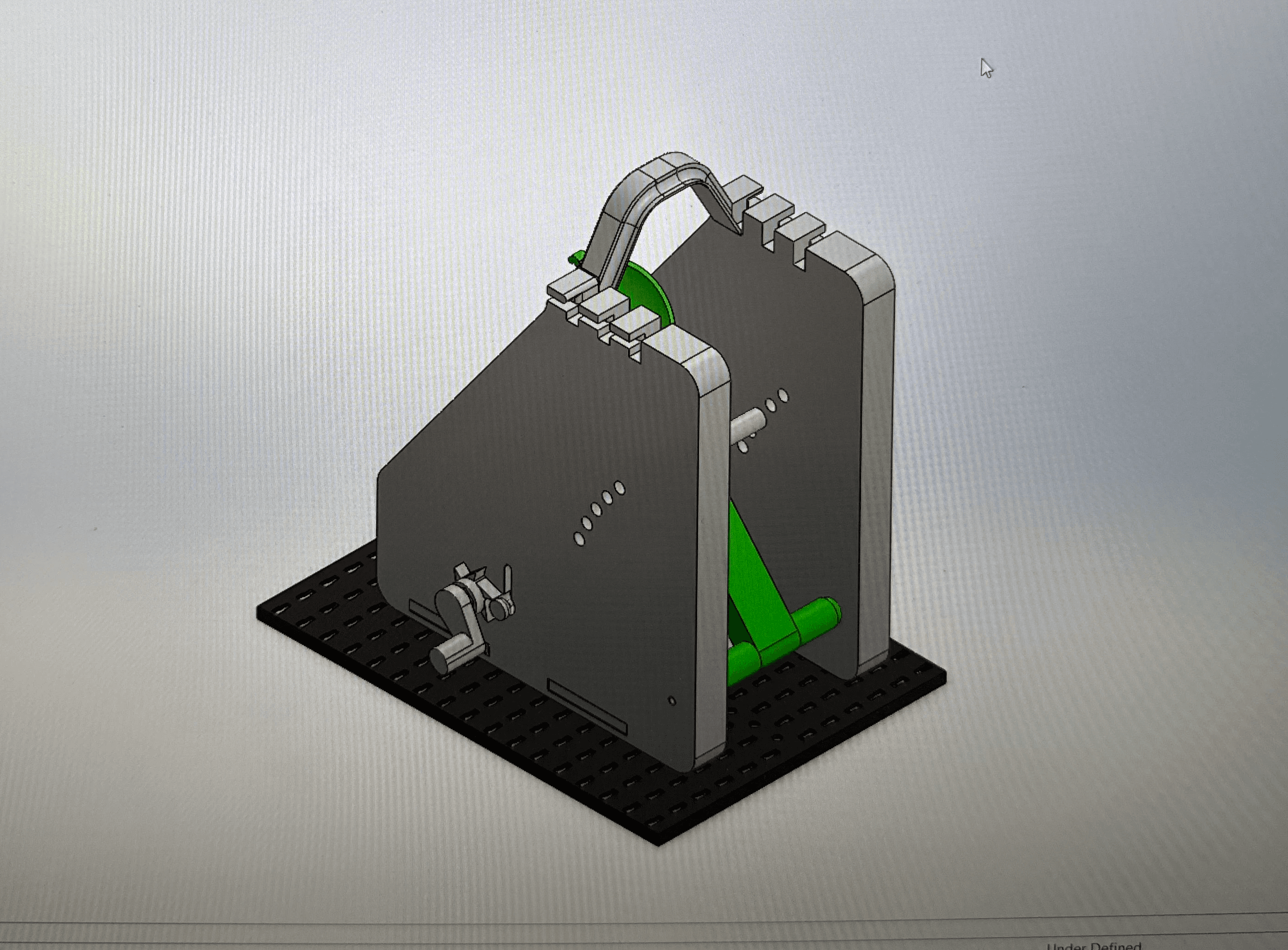
Given our design constraints of 3D printed parts and the inclusion of a motor, we decided on a traditional catapult design, utilizing the rubber bands given to produce potential energy. Our design lead, Dylan, designed a ratcheting design, derived from click pens, to lock the motor into a specific position. Rilo and Tomoki designed the catapult arm and the side walls respectively, while I added refinements, such as the rubber-band support, to provide additional clearance for the ball's trajectory.
Our catapult design went through multiple versions, initially starting from a rough assembly, to adding multiple holes to adjust the stopper distance, adding braces at the bottom for stability, adding chamfers for structural stability, and iterating our crank design to optimize its length and path for the string. For extra points on the project, we changed the bottom platform from a fixed design and added slots to allow for pivot rotation.
We designed the parts in SolidWorks and created an assembly file, creating drawings from those files. Rilo and Tomoki also developed the project poster, outlining our design process, bill of materials, and drawings.
Outcome
Our catapult exceeded the requirements, traveling 20% further. Our optimization of parts meant that less work was required to reach the same distance, bringing us to the top 10th percentile of the class. The motor integrated well with the design as we had planned, successfully winding the catapult's string and launching the ball.
Standout Features
Innovative ratchet design
Rotating platform
Modular design to be flexible towards multiple targets
Adjustable stopping points and rubber band support connections